Getting readers is a tricky business

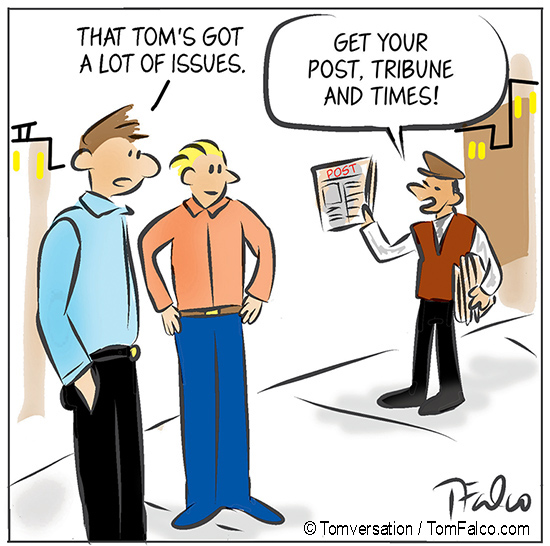
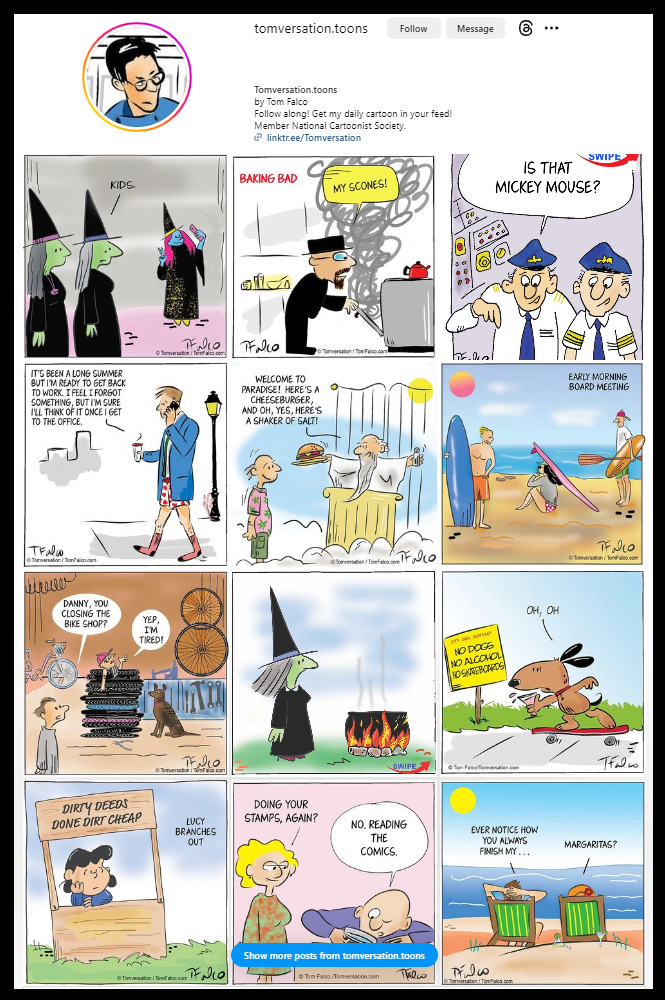
I’m not getting the readership I want. I want millions of followers and readers. To be fair, some of my cartoons do get millions of eyes on them. Most of course, don’t.

I read one time when the comics were revered, I guess in the 1940s and 1950s, Al Capp would get 80 million readers a day for Li’l Abner. If he got that size readership, I’m sure most of the big name strips at the time, did, also – Blondie, Moon Mullins, Dick Tracy, Little Orphan Annie, etc.

While many cartoonists get many views, many don’t. If you look at sites like GoComics.com, those big cartoonists who you would think have a lot of followers, don’t.

I am resigned to the fact that I have fans that get me. I like to think my cartoons are more cerebral. Not on purpose, it’s just how I think. I’ve noticed when I have a silly cartoon, something that plays to the lowest common denominator, well, that’s when I get all these eyes on my work.

A lot of my cartoons are “stolen.” What I mean is that they are picked up and used in anthologies without permission. These jerks at one publication one time picked up 60 cartoons and published them without permission, then other sites similar to their site (clickbait sites) picked up the cartoons and published them and so on and so on.

When I complained about the 60 cartoons being picked up and rerun, they reduced it down to 30. Guess they don’t know the word plagiarism.

Recently, a friend sent me a site where one of my cartoons was published, it was there along with some others which were illegally picked up and reused. My name and copyright were removed from the cartoon, but I was impressed that my friend recognized my work. He knew my style.

When I complained to the site editor, they said, “We did link back to you!” I had to tell them that they linked back to another site that illegally swiped my cartoon. I guess this is journalism today – anyone can publish anything without anyone editing or checking them. Sort of like I do here on my blog.

But it’s nice to know people think the work is worthy of stealing, or maybe it’s just that they need clickbait and anything will do.

I like to create my cartoons thinking of cartoonist Jason Chatfield’s quote: “Don’t curate your art to what gets likes. Curate it to what you like.” So I’ll keep on doing it that way.

By the way, if you are not subscribing, you can subscribe free via email to my cartoons here – five (that week’s worth) will arrive each Friday plus two short blog posts are published during the week.

Till next time . . .

Enjoying making them happy

The Thinker – Me.

When I’m creating a cartoon, I usually have one or two people in mind. I wonder, “Will they think this is funny? Will they like it?”

I don’t know why them. Probably because they are more vocal about my work and they have sent me cartoon ideas over the years, so I feel they are paying attention, even thought I might use 1 in 100 of their ideas – but they are being involved.

When I was publishing the daily news, there is one person who I would think of, too. I would wonder if she thought I was doing a good job. I wondered if she thought the article I was writing made sense and wondered if she would approve. She was always in my head as I was writing.

This person is gone now, but I always admired her and cared how she felt about issues. I admired her as I was growing up, she was always saying what I was thinking she was a fighter and protester. She cared about life and history. One time I saw her in person and was so excited. I didn’t say anything to her, but it was like seeing one’s favorite movie star in person.

Years later, I ran into her at a protest, and she knew my name. She literally knew who I was, she approached me and introduced herself and said my name! We eventually became friendly over the years. She wrote a book on Miami history one time and included me!

Are there people who you try to impress? But I think impress is not the right word, I don’t know what the word would be. Make happy? Entertain? Not sure.

One of my favs from quarantine time. Via TomFalco.com

I think in my cases, I just admired these people and the way they felt about things, so I wanted to try to entertain them with my work and put a smile on their faces when they see my cartoons and writings. I don’t want to lose them as an audience.

To be honest, I don’t think I ever changed an article or cartoon because “they” wouldn’t approve, but I just hoped they would enjoy what I was doing.

Does any of this make sense?

Subscribe to this Tomversation blog by clicking here – it’s free! 

Loving this cartoonist roundtable

roundtable
From left: Tom Heintjes, Brian Walker, Greg Walker, Jeff Keane, Mason Mastroianni. Photo courtesy of Hogan’s Alley.

I read a really great interview in Hogan’s Alley, where editor Tom Heintjes sat down with some famous cartoonists,who took over the family business from their fathers and grandfathers. Jeff Keane of Family Circus, Mason Mastroianni of B.C. and Brian and Greg Walker who are Mort Walker’s sons, who work primarily on Beetle Bailey and Hi and Lois sat around a table and talked.

They bring up the dynasty aspect of cartooning, something that has always bothered me. When a cartoonist dies, should the strip continue? Did it run its course?

Greg Walker says, “We’ve got to do quality work, or papers will drop us like crazy. We did come in with a nice list, but there’s the pressure to maintain it.”

I never really thought of that. It has a leg up being a popular strip with lots of newspaper subscribers but as one of them said in the interview, “When you’re at the top, there is only one way to go.” But on the other hand, newspapers are loath to drop a comic because losing just one subscriber over that is not acceptable, so I do think that some of these older strips just stay there year after year because the newspapers don’t want to make waves by dropping them, even if it’s only a handful of people who read a particular strip.

They all agreed that the older strips mixed with the newer strips make up a complete comics page and there is something for everyone that way. I’ve always agreed with that, I just felt that the older strips should be the original older strips, not an extension by the second, third and sometimes fourth generation of artists. And don’t get me started on those who buy gags. To me a cartoonist writes the strips and draws the strips, sometimes along with someone else, but purchasing gags just makes the cartoonist an artist, not a cartoonist.

Brian Walker says of his dad Mort Walker: “My father has been asked millions of times why he doesn’t retire, and he says, ‘Why should I retire? I’ve got millions of readers who enjoy my strip!’ Why should he retire just because he’s getting old? When he started out, in 1950, he was competing against Pogo, Li’l Abner, Dick Tracy, Little Orphan Annie. None of those guys quit to make room for him — he scratched and clawed for every one of those 1,800 papers.”

The roundtable interview is here. It’s really good.

10 things you didn’t know about Rina Piccolo’s groove

10 With Tom
10 questions in 10 minutes


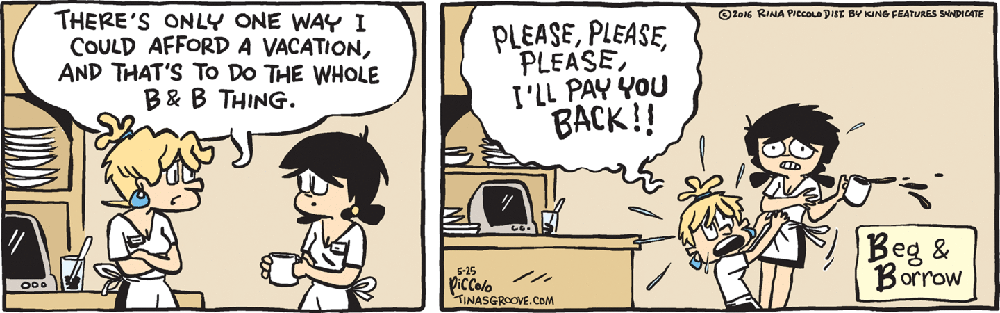
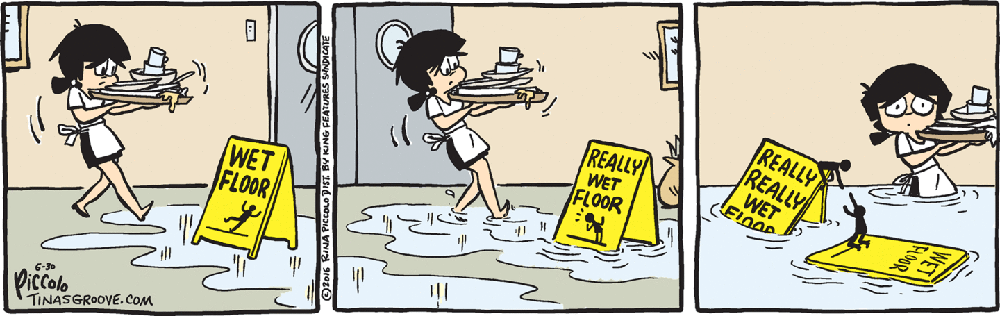
Rina Piccolo is a syndicated cartoonist, best known for her daily comic strip “Tina’s Groove,” which revolves around Tina, a waitress at Pepper’s Fine Dining Restaurant. Tina’s Grove started in 2002 and is distributed by King Features Syndicate. She also does lots of other single panel work for magazines and has filled in for other cartoonists. I think the best part is her name – Rina Piccolo – very musical.

rina-piccolo
Cartoonist Rina Piccolo

TOM: You do the Tina’s Groove comic strip and I’ve seen single panel gag cartoons, and also sometimes fill in for Hilary Price for Rhymes With Orange and I’ve also seen Six Chix in the past. How do you decide what gags to use for which comic strip or gag cartoon?

RINA: It’s a wonder that no one has ever asked me that because it’s an issue that I encounter often, and it can sometimes be really frustrating. I mean, I have all these outlets for cartoon ideas (well, I no longer do cartoons for Six Chix, so there’s one outlet gone), and it’s often hard to see where best to use them. Sometimes ideas choose for themselves where they want to go. Like, for instance, all restaurant/workaday gags would obviously be used for my strip Tina’s Groove, since it’s about a waitress and her co-worker friends. And if I ever have an idea that’s too racy for the newspaper comics, then I try to shop it around to various magazines that publish cartoons in the style that you see in the New Yorker. On the occasion when I’m filling in for Hilary Price’s Rhymes With Orange comic, I usually have a couple of gags in my drawer that I can’t use for any of my outlets, and what I do is combine these with fresh ones that I sit down to write specifically for the Guest Spot.

TOM: Tina is a waitress, were you ever a waitress, you seem to know so much about the restaurant business?

RINA: Let me admit it right away– I make a terrible waitress, ha ha! However, I have worked in several restaurants in other capacities (kitchen, and counter service). In the last restaurant that I worked in I was the Hostess, and interestingly enough, it was while I was in that job that I had cooked up the idea to do a strip about a waitress, and life in the service industry. Anyway, as I say, I never made it as a server — once, in a small café that I worked in as sandwich-maker/kitchen help, they needed someone to fill in temporarily as a server, and so I served tables — for about 15 minutes. That’s how long it took for the owner to tell me to go back to the kitchen. Ha! Anyway, all this just to say that the reason I know what I know about the restaurant business is because nearly all of my “real” jobs were jobs in which I worked with the public. Anyone who’s worked with the public — and not just the restaurant business– shares the same sorts of experiences. That’s basically what fuels Tina’s Groove.

tinasgroove1

KING FEATURES SYNDICATE

Tina’s Groove

TOM: How long did it take for Tina’s Groove to bet syndicated? Did you submit the feature to many syndicates? Did you submit other features? What were those about?

RINA: Like nearly every cartoonist at the time, I submitted stuff to all the major syndicates, with no real success. Then, in 1997 or thereabouts, Jay Kennedy, the comics editor (at the time) of King Features syndicate, had become familiar with my single panel gags from contributions I was making to “The New Breed”– a single panel daily that had a different cartoonist every day of the week. Anyway, he called me — this was back in the days when people actually used to use the phone to call people, ha ha. And the weird thing is, the call came one afternoon when I was putting together a submission to King– I mentioned it to him, and he said, “Put my name on it, and I’ll make sure it gets straight to my office”, or something like that. When I hung up I felt stunned. It really felt like it was written in the stars, or something silly like that. But the feeling of having a wide open door to a syndicate deal was fleeting, because what followed was three or four years of going back and forth with Jay, submitting strip premise ideas and character ideas, with no guarantee of a contract. On about the two or three year, I took one of the characters I’d been working with and made her a waitress. When Jay saw it, he liked it enough to encourage me to move in that direction, and from that was born “Tina” from Tina’s Groove. But I should stress that I had always wanted to do a single panel gag cartoon, and not a comic strip with characters. Apparently the trend at the time made character-driven strips more marketable, and Jay was only interested in seeing comic strips; he encouraged me to go in that direction, so that’s what I created. As for the other characters & strip ideas that I submitted to Jay in those years I can only say that there were several, and I can barely remember a couple of them – one of them was a kid strip that featured a little girl who narrated her views of the world around her, and another was an actress character whose roles in movies became adventures in the strip. Or something like that. My old brain can’t recall most of the crap I wrote at the time!

tinasgroove2.gif

KING FEATURES’S SYNDICATE

Tina’s Groove

TOM: How do you work? What is the schedule like?

RINA: I do have a schedule. My schedule is that I work all the time, ha ha! Seriously, I am one of those people who just really enjoys this stuff a lot, and I seem to have an eagerness to constantly create stuff. I pencil and ink Tina’s Groove on Monday, write material on Tuesday, and part of Wednesday, pencil and ink the Sunday cartoon on Wednesday, and then I have Thursday, Friday, Saturday, and part of Sunday to work on other projects– personal or paid work. If I have a free evening I like to goof around in my sketchbook.

TOM: Although cartoonists seem to be alone most of the time, they seem to be a cliquish group. What other cartoonists are you friendly with?

RINA: Yes, the industry is pretty small — at least the world of syndication is — and everybody kind of knows everybody else. Some of us have great friendships that last years and years, and yes, even romances. But like you say, cartoonists spend an awful lot of time alone, and so when we get together, well, it’s what you’d imagine — a lot of catching up, a megadose of shop talk, and some gossip thrown in. I love my cartoonist friends. The ones I hang out with, or keep in touch with, in person, or through Skype, are Sandra Bell Lundy (Between Friends), Paul Gilligan (Pooch Cafe), Cathy Thorne (Everyday People Cartoons), Susan Camilleri Konar (Six Chix), Anne Gibbons (Six Chix) ( in fact you can include all of the Six Chix ladies, as we Skype now and then), Hilary Price (Rhymes With Orange)… oh boy, there are more, but do I have the space here to list everyone? When I lived in NYC I used to hang out with a lot of cartoonists in the NY, NJ, and Connecticut area. I think the reason why cartoonists are “cliquey” is because we relate to one another in a way that others just don’t, or can’t. Cartooning is an uncommon profession. (It’s not like the typical neighborhood comes with a couple of pro cartoonists in it.) Since it’s such a rarity, it’s nice to have a friend that can totally relate to you when you say something about penciling, or inking, or anything like that, without having to explain (which I think would be boring for people who don’t cartoon).

TOM: Digital or pen and ink?

RINA: Both! I use a Cintiq Companion to pencil and ink Tina’s Groove (also used it for last two years of Six Chix, and my guest weeks on Rhymes With Orange). And I use a brush, pen, and ink to draw gag cartoons (magazine gag cartoons, and lately for the book I co-authored, Quirky Quarks: A Cartoon Guide to the Fascinating Realm of Physics.) I also do a lot of sketchbook drawings in a paper sketchbook. Sometimes I draw on my iPad, or Cintiq for animated Gif art, and things like that.

tinasgroove3

KING FEATURES’S SYNDICATE

Tina’s Groove

TOM: What was the first thing you would seriously draw? I mean, I would draw Fred Flintstone, I always remember as a young child doing that. Did you draw a character or have a favorite subject at a young age?

RINA: Horses. I’ve always loved horses, and when I was a little girl I used to try to draw them all the time. I still can’t draw a horse. Well, not a good one.

TOM: What famous artist, dead or alive, would you want to paint your portrait?

RINA: Jackson Pollock… Ha, ha, kidding! (Although he’d get my hair right.) … Seriously, good question — I really don’t know. John Singer Sargent would certainly make me look good in brush strokes. No way I’d let Robert Crumb draw me– I think he’s a master, but he’d probably give me a bulbous butt.

TOM: Favorite movie of all time?

RINA: The Wizard Of Oz. That movie does something to me. I’ve watched it numerous times. It never gets old.

TOM: What other comic strips/panels do you enjoy? Past and present.

RINA: I wouldn’t call myself a humongous consumer of comics, weirdly, but I do enjoy a lot of them. In fact, too many to list here—and many are created by people that I know personally. My all time favorites, I can say, are Lynda Barry’s “Ernie Pook’s Comeek”, and anything by Roz Chast (especially her longer-form stuff). I’ve always loved these two because their stuff makes me literally laugh out loud — and I know how difficult it is to have that effect on a reader.

TOM: Thank you, Rina. Enjoyed the chat!

See all my 10 With Tom interviews here.