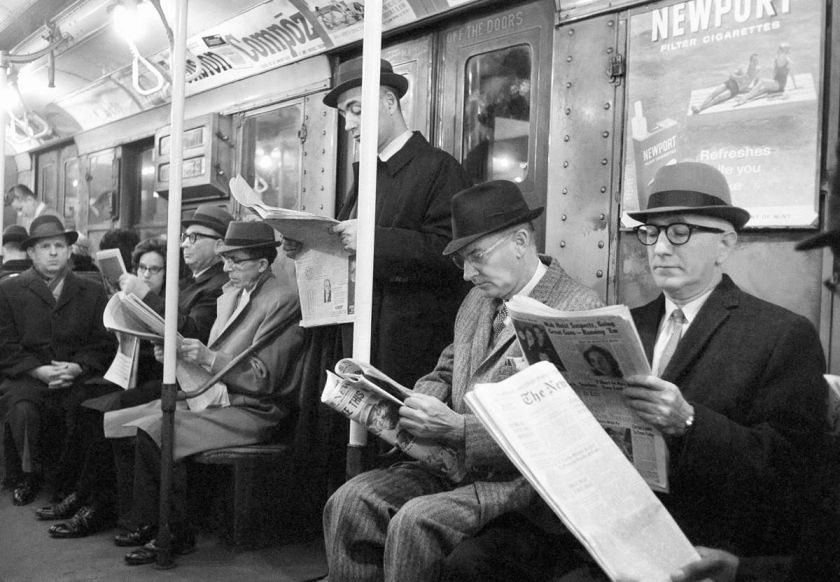
A guy posted this old photo of people reading the newspapers on a subway in NYC on a Facebook page I follow. He commented on how people used to read the papers daily and mentions that he hasn’t read a paper in years. I mean years, like since the 1990s, he says.
If he felt some sort of way to post the photo, why not support the newspapers once in awhile and buy printed copy? He makes it seem like something from the past that can’t be attained anymore, when all he has to do is go out and buy one – a fresh one, printed today with today’s news and features!
Other people were mentioning that they hadn’t read a printed paper in years. And I don’t know why, but it really got me pissed. I’ve learned to keep my mouth shut these days so I didn’t comment or reply to any of them but I felt like telling them all off. They all sound like people of certain age, one guy was mentioning reading the New York Journal-American for God’s sake, I think that went out in 1966, so doesn’t he feel sort of an obligation or curiosity to at least pick up a paper now and then?
I had posted this great video about the NYC newspaper strike of 1945 here in the blog awhile back; I watched it again the other day on my tv- it was so enjoyable on the big screen.
I’ve spoken before about dumping the daily newspaper, but I can’t do it. I tried going just digital, but for some reason, I need to hold it in my hands and read it that way every day, even though I’ve gotten 99% of the news and features on the internet the day or night before.
======== Don’t miss my next post. Receive Tomversation via email each time I publishClick here. =======
I recently wrote a story on Joseph Pulitzer, and then my next story, interestingly enough, is on a brand new Pulitzer Prize winner.
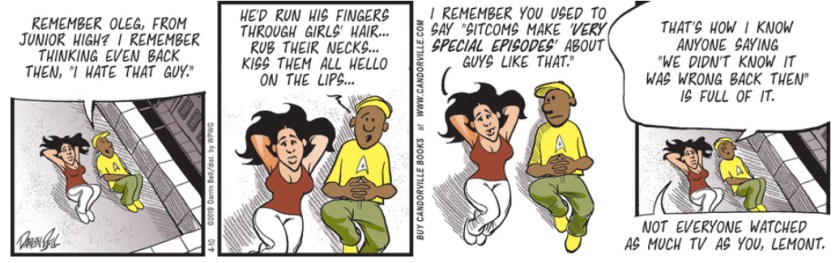
Earlier this week, cartoonist Darrin Bell (left) won the Pulitzer Prize for his political cartoons, he also does a daily comics strip called Candorville, which incorporates another comics strip which he produced for many years, called Rudy Park.
TOM: Congrats on winning the Pulitzer prize! How did you find out?
DARRIN: Thank you. My editor at the Washington Post Writers Group called me at my home in California and told me. They flew me out to DC a couple days later so I could be in the Post newsroom during the announcement.
TOM: You do (or did) three comics – two comic strips and an editorial cartoon. I see you combined the two comic strips – Candorville and Rudy Park. How did that come about?
DARRIN: My syndicate realized Candorville and Rudy Park didn’t share any clients, and since I’d already done several crossovers between the two series, they suggested I combine them.
TOM: I also heard you draw story boards for films and tv?
DARRIN: I got a call out of the blue back in 2012 asking me if I knew how to draw storyboards. Coincidentally I’d taken a class in storyboarding just for fun a few months earlier, so I said sure, and ended up storyboarding a sci-fi pilot for Anthony Zuiker (CSI). I added my name and portfolio to a bunch of job sites, and then answered inquiries. I only accept jobs when I’m far enough ahead on my work, or if they’re flexible with their deadlines.
TOM: What is your schedule like when you were doing two strips along with the political cartoons and story boards? Did you work on Rudy Park one day and then the next Candorville, etc?
A recent Darrin Bell political cartoon. Image courtesy King Features Syndicate
DARRIN: Rudy Monday’s, Candorville Tuesdays and Wednesday mornings, editorial cartoons Wednesday afternoon and the rest of the week, New Yorker submissions whenever I was awake enough after putting the kids to bed.
TOM: Do you work digitally or old school pen and ink?
DARRIN: Digitally. It’s the only possible way to get that much work done. When I worked with paper and ink, I would spend an entire weekday just cleaning cartoons up, scanning them in and getting them ready to color. An entire day.
TOM: What is your studio or work place like?
DARRIN: Quiet office space with red brick walls and ornate windows, one block from a river.
TOM: Favorite scifi tv show or movie?
DARRIN:Babylon 5, a show that chronicles the struggle against new authoritarian governments on earth and throughout the galaxy. The show’s far more relevant now than it was in the Nineties, when it first aired.
TOM: As for comics, which ones influenced you growing up?
DARRIN: X-Men and Spider-Man, mostly.
Candorville by Darrin Bell, courtesy GoComics.com
TOM: Other than those, which comic strip would you like to crawl into, current or past, and spend the day?
DARRIN: Buck Rogers. Or the Star Trek comic strip from the 80s.
TOM: If you could go back in time and change one thing, what would it be?
DARRIN: I’d stop whatever cataclysm destroyed ancient civilizations all around the world 13,000 years ago (probably causing all the great flood myths and destroying Atlantis). That worldwide destruction forced the survivors to start all over, almost as if an advanced civilization was returned to the Stone Age. We’d be 13,000 years more advanced than we are now. There’s a good chance we’d also be 13,000 years wiser.
TOM: Thanks, Darrin, and congratulations again on the Pulitzer!
======== Don’t miss my next post. Receive Tomversation via email each time I publishClick here. =======
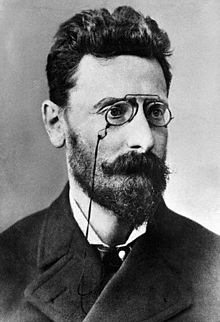
I saw a great documentary on Joseph Pulitzer (left) the other night which of course was a lot about the New York World, which he published from 1860 until his death in 1911, after that his sons ran the paper (into the ground) and then in 1931, it merged with the New York Telegram to become the World-Telegram and then years later, in 1950, became the World-Telegram and Sun. You can see the Pulitzer documentary in full at PBS’s American Masters here. The story is great along with the images of the old newspapers and offices and of course, old black and white movies of street scenes and society at the time.
What was interesting about The World was that it seemed to have everything, especially on Sundays. It would print dress patterns, color comics, cut outs that kids could play with and had stories that were not breaking news, but features. Pulitzer and his staff would seek out human interest stories, which was a first for its time. He also designed interesting layouts and pages which were completely different than what was standard at the time – rows and rows of columns.
The World was one of the first newspapers to run comic strips and it started with the Yellow Kid which was stolen by Hearst his New York Journal (later the Journal-American).
One interesting item the documentary talks about was timing. When Pulitzer began publishing The World, New Yorkers started taking public transportation more often and the newspapers at the time were a perfect diversion on city transit.
I always loved old photos of the World building down on Park Row, across from city Hall. It’s gone as of 1955, and I found out from the Pulitzer documentary that it was due to Robert Moses, who seemed to destroy a lot of NYC in the name of progress, including the demise of the Brooklyn Dodgers, to which my father has not forgiven him to this day. Moses demolished the World and Times to build another ramp for the Brooklyn Bridge.
These clocks can still be seen on the Sun Building today at 280 Broadway.
The Sun building was next door, but eventually moved to 280 Broadway, on the other side of City Hall, where the is still today. Clocks on each corner show the name – “The Sun – It shines for all.” The Sun came back in the early 2000s but is only online now.
Beautiful newspaper row.
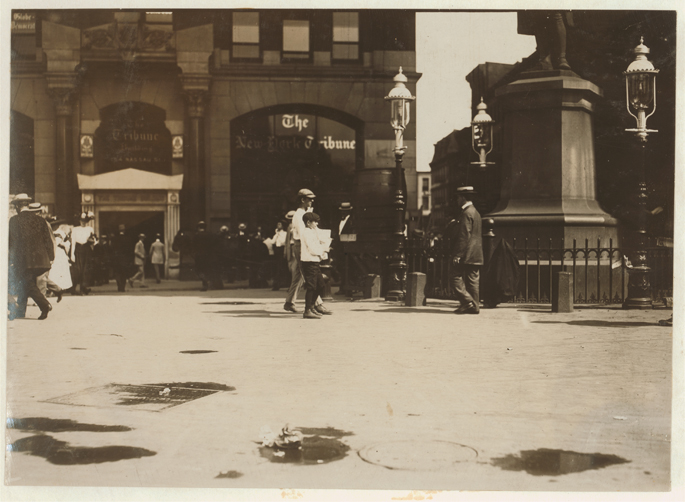
The New York Tribune building was demolished in 1966 and is now Pace University.
The New York Times building at 41 Park Row is still there today. People mistakenly have claimed over the years that it was demolished for the Brooklyn Bridge entrance, too, but that is not the case. It is also part of Pace University today.
Of course, one of my favorites was the Herald, up on Herald Square, which is now an ugly box building housing Santander Bank and CVS, catty corner to Macy’s.
The New York Herald.Outside the Tribune Building.
======== Don’t miss my next post. Receive Tomversation via email each time I publishClick here. =======
The New York Post has two of the best headlines this week.
Today’s paper is about Jeff Bezos being blackmailed by David Pecker.
If you haven’t seen the news, Bezos, owner of Amazon and the Washington Post is being blackmailed by David Pecker, publisher of the National Enquirer. Pecker is threatening to expose Bezo’s pecker, literally, he has naked pictures of him. Story here.
Yesterday’s cover is a play on the slogan, “Virginia is for Lovers.” The top guys in the state are all in some sort of trouble for either donning black face in their youth or sexual harassment. Story here.
These headlines are right up there with the NY Post’s 1983 headline: “Headless Body Found in Topless Bar.”
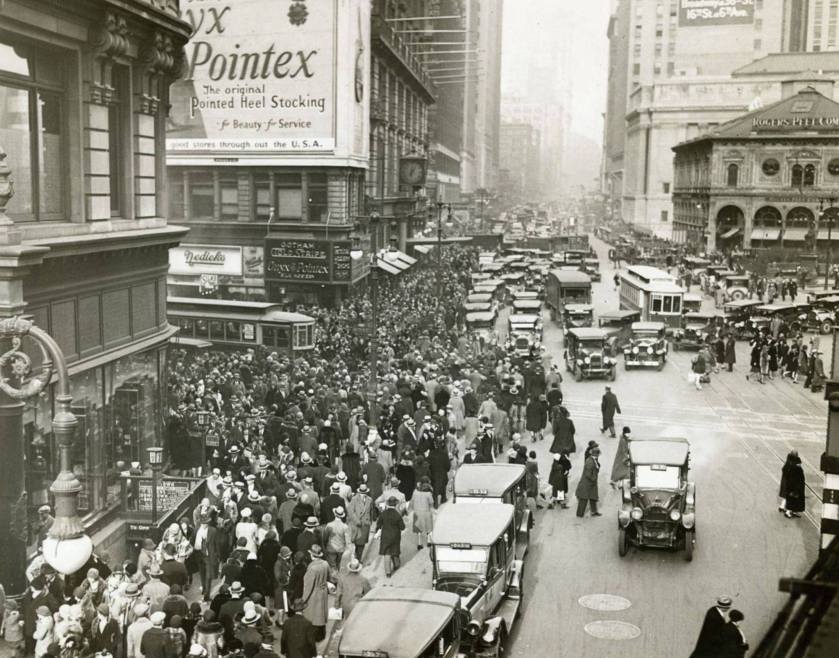
This is Christmas shopping at Herald Square in 1930. Love this photos, as it shows the New York Herald building at the upper right and at left is Macy’s.
The Columbus Dispatch (love that name Dispatch, for a newspaper), dropped the daily reruns of Peanuts, they say they have been paying thousands of dollars a year for the rights to print the reruns. While it’s true that Peanuts is a money machine, should new features be run in the newspapers, leaving the legacy strips to online locations?
I’ve always felt that when a cartoonist retires or dies, the feature should go with them. I sort of was hesitant after reading the Cartoonist Round Table article awhile back, I wrote about it here. But should the comics pages make way for new features when a cartoonist is done?
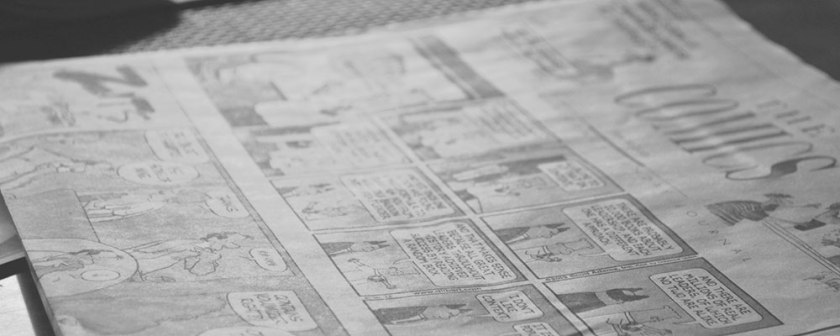
I do enjoy Dick Tracy and Nancy, which have new cartoonists and writers but I also read them online, like I read most of the comics now. I rarely read them in the newspapers, for one thing, the newspaper editors have terrible taste and they don’t run the comics I like, for another thing, they are too small to read in the newspapers. I also posted an image once of one Sunday page where the panels were smaller than postage stamps!
I think most readers these days read the comics online, simply because most readers are younger and that’s where they get their news and entertainment and the newspapers are dropping many comics and features as they tighten up the printed paper.
There is an interesting column in Tedium, called, “Rethinking the Funny Pages,” where writer Ernie Smith says the newspapers comics are starting to “age out.” The column was written in February after Mort Walker’s death and the change over of Nancy. He also claims that the future of comics is online. It’s an interesting read.
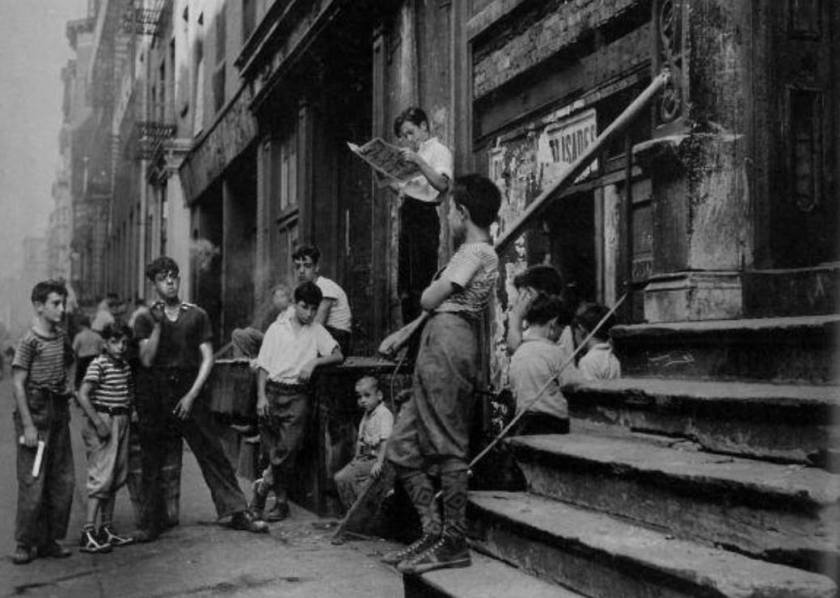
Here’s a great photo from the 1930s – a bunch of boys hanging out on Sullivan Street in Brooklyn. I like that the boy at top reading the newspapers looks as if he’s reading the comics. It sort of looks like the Daily News Sunday comics section. Doesn’t it?
Years ago I worked for a local newspaper, it published three days a week, that is where I got my start in the newspaper business. It was the mid-80s. I remember my boss telling me that one day, there would be a thing called “pagination,” where the whole page would come out as one thing – the headlines, the columns, the photos. We all stood back in awe at the thought of that.
At the time, everything was done separately, we used exacto knives or razor blades to cut and past, I preferred the blades. We had a waxing machine and waxed the stuff and placed it down on blue-lined boards. I remember years before that I went on a tour of The New York Times, I think it was in junior high school, and they had the hot type method which is really ancient by today’s standards.
One machine was used just to create headlines, another for the columns of text. For the photos, we cut in red material that came out clear when shot in the back camera room and the photos which were shot separately were then stripped in. It was a process.
I remember when I started my own graphics business a few years later and we had Compugraphic machinery that actually allowed us to change the fonts on demand! We didn’t have to stop the whole operation and change fonts.
When computers started being used in the process, I asked one of my brothers who was in the computer business if he knew of a way where we could change fonts on the computer. He said there is possibly a way but it would be hard to program. I just wanted a few fonts to switch back and forth from. Crazy to think of now, huh where we have thousands of fonts at our disposal.
My comics had brought me to the newspapers business. I had submitted a bunch to the newspaper and they called me to come in one time, when I went in I found out that they weren’t interested in my comics, but they wanted me to work at the newspapers in the production department, which ended up being my design future to this day.
I did draw a lot for them though, I did a lot of cartoon work for ads that people placed and also I did political stuff. I’m sure I have those old newspapers somewhere, probably in my parents’ garage or something. I need to go look for them.
I’m not sure why I am obsessed these days with the old New York Herald building. This past summer I spent a lot of time in front of the old site looking at it. It’s an ugly mid century (1960s) square block building now with a bank and drugstore in the space.
I was standing to the right of the trolley shown at the right of this photo; standing right in front of the site. Macy’s is the left today.
One day I was on my way to meet a friend to see Hello Dolly, 10 blocks away, and on the way I stopped here and just contemplated the location. So much history is still in New York, but so much is gone. I saw Hello Dolly in the Shubert Theater, which was opened in 1913. The Herald building was standing at the same time a few blocks away.
The Herald building opened in 1894 and they left around 1924 after a 30 year lease. A clothing store took over the location and retrofitted the newspaper offices and press room but around 1940, the building was demolished for the ugly new structure that is there today, which is almost 80 years old. The actual newspapers only lasted in that location for 30 years.
You would think Herald Square would have kept the Herald building. Times Square still has the Times building. It’s behind all those neon signs, you have to look hard to see it.
The ugly building that replaced the NY Herald at Herald Square.
They went from printed publication to online publication three years ago, but that was good, as so many publicatons are going online. But now it is totally gone.
I read it in Gothamist, but Gothamist was dead for a bit but they were resurrected so who knows. Maybe the Voice will come back.
The Village Voice was special to me because it was my foray into New York City when I wasn’t in New York City.
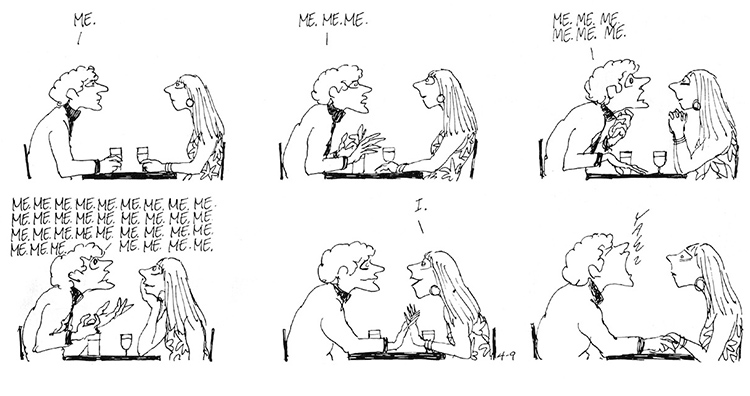
Feiffer cartoon.
For most of my life I spent a lot of time in NYC, even though home is Miami. But ever since I was a boy, I would go to NYC and spend long periods of time there. I would go during high school vacations and sometimes spend months there and even now I will spend long periods of time there. I spent weeks there this summer and I’ll be back for ComicCon next month and then Thanksgiving in November so the Village Voice was how I kept up with New York when I wasn’t there. And you know what? I don’t think I ever actually read it while in New York. I think it was just my taste of NY when I wasn’t in New York.
There was something forbidden about it when I was 16, I don’t know what, maybe the backpage ads? Maybe the articles? Whatever it was, I would read it in the library at high school and college and also at our town library. It was so New York-y that I felt as if I was in New York when immersed in it.
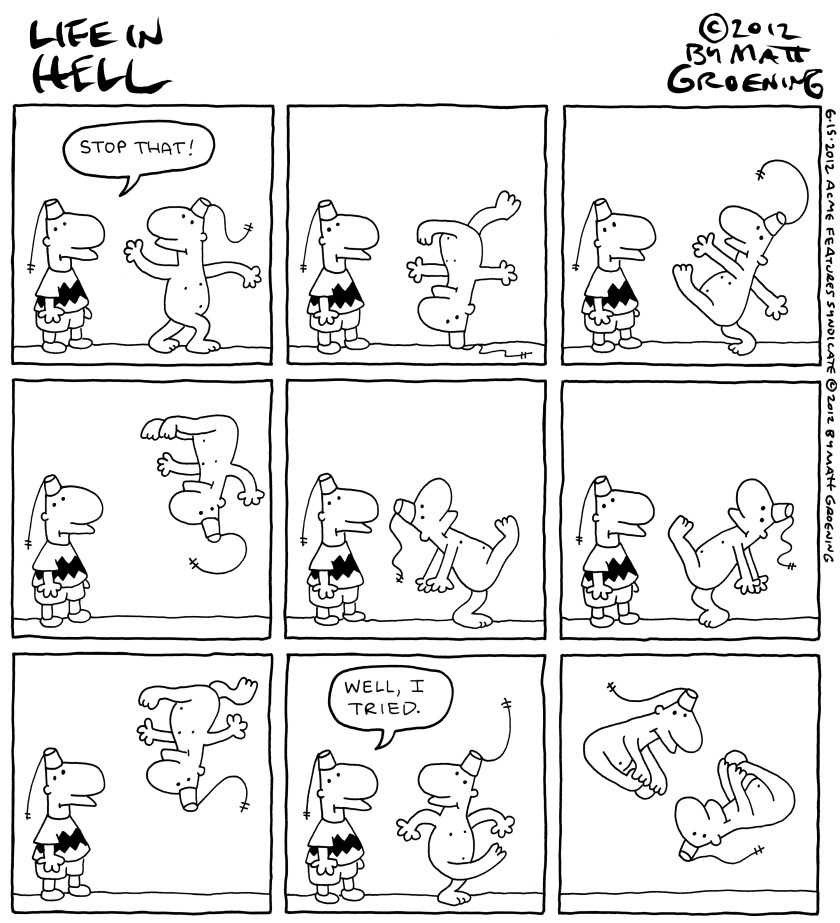
Life in Hell, by Matt Groening
I loved the early cartoons as well as the articles. Jules Feiffer, R. Crumb, Matt Groening, Ted Rall, Tom Tomorrow, I could go on; such great cartoonists. I read them all.
I remember at one time their address was on University Place in New York and every time I walked by or crossed University Place, even to this day, I think of the Voice. I don’t think I ever sought out the building, but just seeing the street name reminds me of The Village Voice.


 Earlier this week, cartoonist


 I saw a great documentary on Joseph Pulitzer (left) the other night which of course was a lot about the New York World, which he published from 1860 until his death in 1911, after that his sons ran the paper (into the ground) and then in 1931, it merged with the New York Telegram to become the World-Telegram and then years later, in 1950, became the World-Telegram and Sun. You can see the Pulitzer documentary in full at










 tomversation.com